Sunday, October 19, 2008

Short Lesson in Taal Geology

I promised a lesson in the geology of Taal volcano, so here it is. I’ve gathered this from sources on the web. Originally it was a massive peak about 18,000 ft tall (almost 5 and a half kilometers). Tagaytay would have been only about 0ne sixth up the slope. To give you perspective, Mt. Mayon, another famous Philippine volcano, is less than half that high. And it would be another 4000 ft taller than Mt. Rainier!! It is thought to have built up about 140,000 years ago. Then, in a series of eruptions from about 27,000 to 5,000 years ago, the mountain blew itself up and collapsed, forming the large caldera that is now filled with Lake Taal. Subsequent eruptions produced several underwater cones as well as Taal Volcano Island.

My mom, who has never been to the island, tells a story of swimming in Lake Taal and realizing only later that the lake was acidic because her skin turned black. That must have been after an eruption. I'm not sure how old she was then.

As you know, it is still active. The most active vents that we could see were issuing steam, and they are located along the side of the lake that is overlooked by the viewing area. I think it is very interesting that steam and heat makes its way all the way to the very rim of the cater. I think it also suggests that that side is the most vulnerable—I could imagine a scene from a disaster movie in which an earthquake causes the viewing area to slide into the crater, carrying tourists with it!

Here is a very nice picture showing the layers built up. It is hard to see but there is steam and hot air coming from the cliff face just below Jo Jo and me.


This picture give you a little more perspective as to scale. If you click on the slide show of our visit on the right, you can find other pictures of venting.

Saturday, October 18, 2008

Beaches of Boracay

For all of our previous trips we did a fair amount of research on the sites, the history, and the culture in preparation for our journey. For our trip to Boracay, we wrestled with the burning question of just how many swim suits to pack… that’s about as deep as our research went!

Boracay was an outing that was really just about landing at a resort, enjoying some sand, sun, and surf, and little else. We got our first taste of the renowned “white sand” beaches and enjoyed time in the very warm waters. Jordan got his first taste of snorkeling in tropical waters, which he thoroughly enjoyed. We all got our first taste of skimboarding, which was a great family activity. We all have matching bumps and bruises on our knees from our less than successful first attempts (pictures forthcoming...of our skimboarding, not our bumps and bruises!). Without a doubt, Jordan is by far the superior skimboarder in the family. He is anxious for our next beach trip and a chance to get back on the board.

Despite the beautiful beaches, warm waters, and spectacular fishes and corals, Boracay has its detractions. It has become heavily developed and is now lined with resorts and shops. It also has a very high density of peddlers selling just about everything and anything. “Manicure, ma’am”, “Sunglasses, ma’am”, “Pearls, ma’am..I’ll give you discount”. Watches, massage, island hopping, magnetic rocks, parasailing, jet skiing. There was literally someone – no, make that several someones – at every turn offering to sell you something and everyone assured you they would give you a good discount. It was overwhelming at times.

What struck me the most was a conversation we had with an 8 year old boy on our last night on the island. We were having dinner at a table on the beach and he and another boy were walking nearby and paused to talk with us. He was very articulate with an easy smile – charming really. He asked us how old Jordan was and we told him, nine years old. He asked if Jordan would stand up and so Jordan did. Both this boy and his friend just started giggling uncontrollably. “He is so BIG” they said. “Why is he only 9? He’s too big”. Jordan was of course a good head taller than the other boy who we learned was 12 and they just found Jordan’s sheer size to be very funny.

That was a memorable moment, but the subsequent conversation was perhaps more poignant. Of course these charming young boys weren’t talking with us just because we looked interesting; they too, were selling something. They had these sets of magnetic rocks – when you throw them in the air they rattle against one another and make a distinctive noise. They wanted us to buy a set for Jordan. As we talked more we learned that there is quite a system to try and regulate the number of peddlers for all these different items and services. To be eligible to sell these magnetic rocks you have to be between the age of 6-14. The boy said they don’t let 5 years olds sell them because they are too young - they might put the rocks in their mouth and swallow them, so it would be dangerous. According to this boy, they go to school during the day, then at night they come out and wander up and down the sand trying to sell rocks to earn money for themsleves and their families.

Now to be fair, I haven’t verified my source here – he was just an 8 year old boy – so maybe this isn’t true at all. But the story struck me none the less. To imagine that they have a system set up for these children to be a part of the local sales force was something I hadn’t considered. Rather than be home with his family, doing school work, or just playing, he is spending his evenings selling rocks – hoping to get 50 pesos a pair (of course the bidding starts out higher). It is quite clear that in Boracay, as in many places we have seen, there is no shortage of poverty, so who can fault these children or their families for trying to earn money. At the same time, it seems like that path offers little hope for ever escaping the poverty they are combating. How many rocks, or sunglasses, or watches, or whatever would you have to sell to actually improve your lot in life? How many items would I need to buy to really help them? Or does it help at all? In the short run…maybe. In the long run…perhaps not.

What is a person to do? What is the world to do?

I have no answers, but being here in the Philippines - more than suburban Edmonds - is certainly pushing us to think more deeply about these issues and our role in them.

Friday, October 17, 2008

Philippine Transport

Hi, everyone. We've been gone to the great resort island of Boracay and so haven't had the opportunity to post. We'll blog on that later, though. Right now I just want to describe my experiences using Philippine transport. So far I have flown, ridden both powered and sail outrigger boats, been driven in cars, and ridden a taxi, a tricycle, jeepneys, buses and trains. I think the only types of transport I haven't ridden yet is the habal habal, a motorcycle that will hold 6 or 7 people, and the version of habal habal locally called "skylab" because it is a motorcycle with a plank running out the the sides on which passengers balance themselves and the bike. Here's a video of one. And I haven't ridden a pedicab, bike, or carabao, either. I've ridden a horse, but for fun, not to get some place, so that doesn't really count. I am most proud of riding the jeepneys and tricycles.

Anyway, the most common transport types are the tricycles and the jeepneys. Tricycles are motorbikes with a passenger compartment added on the side. We rode one in Tagaytay, and you can see lots of them in the pictures from Infanta. They certainly are cheap, but they are noisy and the exhaust is smelly. They can be packed with people like sardines! Some of the trikes that I saw in the funeral procession when I went to Wawa Dam with Binky must have had around 10 people in and on them!

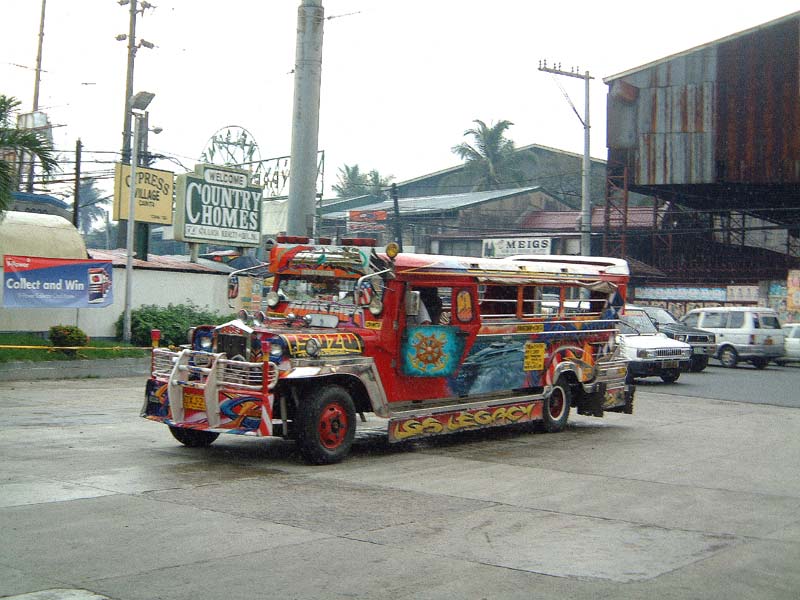
The jeepneys are a particularly Filipino invention. Needing transport after the war, surplus US jeeps were altered to carry many people. They are well-known for their flamboyant paint jobs and decorations. Or at least, they used to be. I have found the Manila jeeps to be pretty drab--they seem more colorful out of town ("in the provinces"). Here's a picture I took of one in Manila and of some in Montalban:
The jeeps have open windows so when it rains curtains or flaps are drawn over them. Each jeep has its own route, which is painted on the side.

When I go to the University of the Philippines (UP), I take a train and ride jeepneys. The trains are light trains, and are very efficient, and air conditioned (although the stations are not)! As in any city, they get really crowded at rush hour.

The fun part is riding the jeepneys. Riding one is certainly a novel experience. When you get on, you pass the fare to other passengers who then pass it on to the driver, who makes change and passes it back to the other passengers, who pass it back to you. My second time on a jeep I ended up being the one sitting behind the driver so I did all the passing of money. I really felt involved and part of the culture!

A jeep carries the driver plus a passenger in front and 16 passengers comfortably in the back. But a jeep is usually packed--the joke is "How many passengers does a jeep hold? Always one more." I've ridden one with two passengers packed in front and at least 20 squeezed in the back, and I've seen them in the provinces with passengers hanging on the sides and back and riding on the roof. Once you get on you find an empty spot if there is one, or else you just squeeze in somewhere.

The roof is low, especially for a westerner--I've bumped my head several times on the hand-railing along the roof. That combined with the low windows means it is hard to see out and figure out where you are! The open windows means it is noisy and smelly, too--lots of exhaust from the other vehicles. But, hey, it's the way to go!

Traffic is notorious, as we have pointed out before, and one of the reasons is the jeepneys (and tricycles) that need to get to the side to pick up and drop off passengers and then get back into traffic. But i can't help but think that the drivers are amazing: while driving they also collect fares and make change and pass the change back! They hold bills between their fingers (it looks like different denominations are held between different fingers) and they have coins arranged in various containers or places in and on the dash to help them out. It would be dangerous except for the fact that they tend to make change only when stopped or going slowly, and anyway traffic is often slow.

Well, I'd better stop. This was supposed to be a short blog, but I guess it was just too interesting to make short!

That goofy weather gadget to the right...

Sorry about that weather gadget to the right... you have to reset it to Manila each time you visit the blog. To see the current weather and the forecast for Manila you have to click on "settings" and type in "Manila", click "search", then choose "Manila, Philippines".

It doesn't work quite right, but it is the simplest I could find. If you know of a better one please tell us!

Thursday, October 9, 2008

Negros and Other Plans

Here’s an update on the professional end of my sabbatical here.

First, the plans for going to Negros should be more solid by the end of next week. The graduate terrestrial ecology course that Dr. Ong teaches and that is going to Negros meets next Thursday, and I will attend. There will be presentations of what the students did last time (end of August). Also, it will be decided exactly when we will be going. Then, Dr. Ong or his students will contact NPOC-EDC (the company sponsoring the work), who will make our flight plans. At the moment my and Carolyn’s plan is for her and Jordan to fly with me and then come to the field site with me for a few days. What we will do once we get there will depend on the weather and on how far along the new road through the buffer zone is. If it isn’t finished, and especially if it also rains, it would be a very muddy and far walk, and we wouldn’t be able to mist net. But the rainy season is supposed to be over by then (in fact it is supposed to be over by now, yet it’s still raining), so I am optimistic. If we can mist net, Carolyn and Jordan should come along, because they would get to see lots of cool birds up close. Plus, they would get to explore a real jungle! After a few days, they will leave to explore other parts of Negros and perhaps neighboring islands on their own (Carolyn is intent on visiting as many islands as possible!) I’ll continue working at the field site, maybe joining the botany group or other groups to help out. There apparently is also a plan to hike to the top of Mt. Kanlaon, which is 2435 m high!

In the meantime, or I guess concurrently, I will be pursuing learning how to ID insects. I am interested in doing work on soil invertebrates, which I can incorporate into my biology classes, so I want to be able to identify them. I talked to the two invertebrate zoology experts (both grad students) and they said they would be happy to help me learn. One of them is even in the process of identifying insects collected from Negros the last time, so I envision helping him complete some of his work while I learn how to ID. Also, there are entomologist faculty at UP-Los BaƱos (UP-LB), about an hour and a half away, so I plan on contacting them, as well. I’m excited about this!

A few weeks ago--or maybe it was just last week!!--I sat in on an ecology lab class that is taught by one of the graduate students who will be going to Negros and who will be doing the mist netting. Lala’s students, who are seniors, were giving presentations on group research projects they had done at a nature reserve and botanical garden right outside UP-LB on the slopes of Mt. Makiling. That was fun because I got to learn some biology but also be involved in teaching. Myself plus other faculty and graduate students attended the presentations and asked questions and made comments after each presentation. Being there also made me visible to more people in the department, including one of the invert zoologists I mentioned above.

I have also talked to Lala a lot about birding in the area. She is a member of the Wild Bird Club of the Philippines. Lala says that the club goes out almost every weekend, so there is definitely opportunity to birdwatch with other people whom I can learn from. This is a great time of year to go birdwatching because the migrants are now here, so there are a lot more species to see. I really look forward to it.

I had hoped to take a class on developmental genetics at the UP, but unfortunately they are not offering it this semester. Oh, well. I suspect working on insect ID will take enough time.

Plus doing the tinikling, of course! ;-)

Wednesday, October 8, 2008

Hans’ Take on the Volcano Trip

Jordan and Carolyn have written a lot about our trip to Tagaytay and Taal, so I’ll add just my 2 cents worth:

IT WAS AWESOME!

From the weather to having Binky along, to the wonderful birds, to the volcano, to zip-lining, to making our way back on our own… it was a wonderful experience. I of course really enjoyed seeing the countryside and the birds, and exploring the volcano (if you can call it “exploring”). Oh yeah, and doing the tinikling!

If you ever visit Taal Volcano, I hope the weather is as good as we had: cloudy enough to keep the sun from beating down on us all day and to make for a dynamic sky and view, and breezy enough to keep it cooler, but no rain to speak of. And don’t ride a horse—take your time and hike it. Oh, and watch out for the target practice that might be going on behind the restroom. Really!

I also want to recommend the Red Lemon Grill, which is just down the road from our hotel and just about across the street from the entrance to Picnic Grove. It is one of the few restaurants located that far out of Tagaytay, yet was really good. The dishes were all wonderfully presented, with leaves, flowers, and dried-noodles-made-into-small-sculptures on them. Everything was very tasty, and reasonably priced, too. We really enjoyed the dining experience.

I’ll have a little more to say later about “the geology” of the area, as Carolyn mentioned. Until then, cheers!

Planes, Trains, and Automoblies...well almost

A trike, a bus, a train, and a short walk. That was the sequence for the intrepid traveling Landels making their way home from Tagaytay. A car, a boat, a zipline, and a horse also came into play during out trip -but that's another story altogether. The good news is that amid all those modes of transport we didn't get lost, we didn't miss any of our stops, and we didn't leave anything behind!

Stinky, noisy trike - 50 Pesos
Tattered, air con bus - 240 Pesos
Modern elevated train - 45 Pesos

Returning to Manila independently using public transit - PRICELESS!!