Friday, October 17, 2008

Philippine Transport

Hi, everyone. We've been gone to the great resort island of Boracay and so haven't had the opportunity to post. We'll blog on that later, though. Right now I just want to describe my experiences using Philippine transport. So far I have flown, ridden both powered and sail outrigger boats, been driven in cars, and ridden a taxi, a tricycle, jeepneys, buses and trains. I think the only types of transport I haven't ridden yet is the habal habal, a motorcycle that will hold 6 or 7 people, and the version of habal habal locally called "skylab" because it is a motorcycle with a plank running out the the sides on which passengers balance themselves and the bike. Here's a video of one. And I haven't ridden a pedicab, bike, or carabao, either. I've ridden a horse, but for fun, not to get some place, so that doesn't really count. I am most proud of riding the jeepneys and tricycles.

Anyway, the most common transport types are the tricycles and the jeepneys. Tricycles are motorbikes with a passenger compartment added on the side. We rode one in Tagaytay, and you can see lots of them in the pictures from Infanta. They certainly are cheap, but they are noisy and the exhaust is smelly. They can be packed with people like sardines! Some of the trikes that I saw in the funeral procession when I went to Wawa Dam with Binky must have had around 10 people in and on them!

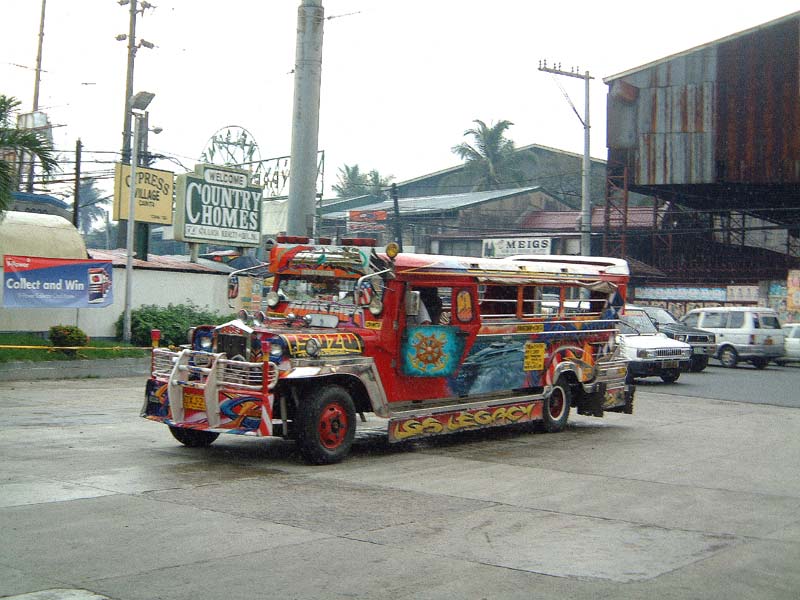
The jeepneys are a particularly Filipino invention. Needing transport after the war, surplus US jeeps were altered to carry many people. They are well-known for their flamboyant paint jobs and decorations. Or at least, they used to be. I have found the Manila jeeps to be pretty drab--they seem more colorful out of town ("in the provinces"). Here's a picture I took of one in Manila and of some in Montalban:
The jeeps have open windows so when it rains curtains or flaps are drawn over them. Each jeep has its own route, which is painted on the side.

When I go to the University of the Philippines (UP), I take a train and ride jeepneys. The trains are light trains, and are very efficient, and air conditioned (although the stations are not)! As in any city, they get really crowded at rush hour.

The fun part is riding the jeepneys. Riding one is certainly a novel experience. When you get on, you pass the fare to other passengers who then pass it on to the driver, who makes change and passes it back to the other passengers, who pass it back to you. My second time on a jeep I ended up being the one sitting behind the driver so I did all the passing of money. I really felt involved and part of the culture!

A jeep carries the driver plus a passenger in front and 16 passengers comfortably in the back. But a jeep is usually packed--the joke is "How many passengers does a jeep hold? Always one more." I've ridden one with two passengers packed in front and at least 20 squeezed in the back, and I've seen them in the provinces with passengers hanging on the sides and back and riding on the roof. Once you get on you find an empty spot if there is one, or else you just squeeze in somewhere.

The roof is low, especially for a westerner--I've bumped my head several times on the hand-railing along the roof. That combined with the low windows means it is hard to see out and figure out where you are! The open windows means it is noisy and smelly, too--lots of exhaust from the other vehicles. But, hey, it's the way to go!

Traffic is notorious, as we have pointed out before, and one of the reasons is the jeepneys (and tricycles) that need to get to the side to pick up and drop off passengers and then get back into traffic. But i can't help but think that the drivers are amazing: while driving they also collect fares and make change and pass the change back! They hold bills between their fingers (it looks like different denominations are held between different fingers) and they have coins arranged in various containers or places in and on the dash to help them out. It would be dangerous except for the fact that they tend to make change only when stopped or going slowly, and anyway traffic is often slow.

Well, I'd better stop. This was supposed to be a short blog, but I guess it was just too interesting to make short!

That goofy weather gadget to the right...

Sorry about that weather gadget to the right... you have to reset it to Manila each time you visit the blog. To see the current weather and the forecast for Manila you have to click on "settings" and type in "Manila", click "search", then choose "Manila, Philippines".

It doesn't work quite right, but it is the simplest I could find. If you know of a better one please tell us!

Thursday, October 9, 2008

Negros and Other Plans

Here’s an update on the professional end of my sabbatical here.

First, the plans for going to Negros should be more solid by the end of next week. The graduate terrestrial ecology course that Dr. Ong teaches and that is going to Negros meets next Thursday, and I will attend. There will be presentations of what the students did last time (end of August). Also, it will be decided exactly when we will be going. Then, Dr. Ong or his students will contact NPOC-EDC (the company sponsoring the work), who will make our flight plans. At the moment my and Carolyn’s plan is for her and Jordan to fly with me and then come to the field site with me for a few days. What we will do once we get there will depend on the weather and on how far along the new road through the buffer zone is. If it isn’t finished, and especially if it also rains, it would be a very muddy and far walk, and we wouldn’t be able to mist net. But the rainy season is supposed to be over by then (in fact it is supposed to be over by now, yet it’s still raining), so I am optimistic. If we can mist net, Carolyn and Jordan should come along, because they would get to see lots of cool birds up close. Plus, they would get to explore a real jungle! After a few days, they will leave to explore other parts of Negros and perhaps neighboring islands on their own (Carolyn is intent on visiting as many islands as possible!) I’ll continue working at the field site, maybe joining the botany group or other groups to help out. There apparently is also a plan to hike to the top of Mt. Kanlaon, which is 2435 m high!

In the meantime, or I guess concurrently, I will be pursuing learning how to ID insects. I am interested in doing work on soil invertebrates, which I can incorporate into my biology classes, so I want to be able to identify them. I talked to the two invertebrate zoology experts (both grad students) and they said they would be happy to help me learn. One of them is even in the process of identifying insects collected from Negros the last time, so I envision helping him complete some of his work while I learn how to ID. Also, there are entomologist faculty at UP-Los BaƱos (UP-LB), about an hour and a half away, so I plan on contacting them, as well. I’m excited about this!

A few weeks ago--or maybe it was just last week!!--I sat in on an ecology lab class that is taught by one of the graduate students who will be going to Negros and who will be doing the mist netting. Lala’s students, who are seniors, were giving presentations on group research projects they had done at a nature reserve and botanical garden right outside UP-LB on the slopes of Mt. Makiling. That was fun because I got to learn some biology but also be involved in teaching. Myself plus other faculty and graduate students attended the presentations and asked questions and made comments after each presentation. Being there also made me visible to more people in the department, including one of the invert zoologists I mentioned above.

I have also talked to Lala a lot about birding in the area. She is a member of the Wild Bird Club of the Philippines. Lala says that the club goes out almost every weekend, so there is definitely opportunity to birdwatch with other people whom I can learn from. This is a great time of year to go birdwatching because the migrants are now here, so there are a lot more species to see. I really look forward to it.

I had hoped to take a class on developmental genetics at the UP, but unfortunately they are not offering it this semester. Oh, well. I suspect working on insect ID will take enough time.

Plus doing the tinikling, of course! ;-)

Wednesday, October 8, 2008

Hans’ Take on the Volcano Trip

Jordan and Carolyn have written a lot about our trip to Tagaytay and Taal, so I’ll add just my 2 cents worth:

IT WAS AWESOME!

From the weather to having Binky along, to the wonderful birds, to the volcano, to zip-lining, to making our way back on our own… it was a wonderful experience. I of course really enjoyed seeing the countryside and the birds, and exploring the volcano (if you can call it “exploring”). Oh yeah, and doing the tinikling!

If you ever visit Taal Volcano, I hope the weather is as good as we had: cloudy enough to keep the sun from beating down on us all day and to make for a dynamic sky and view, and breezy enough to keep it cooler, but no rain to speak of. And don’t ride a horse—take your time and hike it. Oh, and watch out for the target practice that might be going on behind the restroom. Really!

I also want to recommend the Red Lemon Grill, which is just down the road from our hotel and just about across the street from the entrance to Picnic Grove. It is one of the few restaurants located that far out of Tagaytay, yet was really good. The dishes were all wonderfully presented, with leaves, flowers, and dried-noodles-made-into-small-sculptures on them. Everything was very tasty, and reasonably priced, too. We really enjoyed the dining experience.

I’ll have a little more to say later about “the geology” of the area, as Carolyn mentioned. Until then, cheers!

Planes, Trains, and Automoblies...well almost

A trike, a bus, a train, and a short walk. That was the sequence for the intrepid traveling Landels making their way home from Tagaytay. A car, a boat, a zipline, and a horse also came into play during out trip -but that's another story altogether. The good news is that amid all those modes of transport we didn't get lost, we didn't miss any of our stops, and we didn't leave anything behind!

Stinky, noisy trike - 50 Pesos
Tattered, air con bus - 240 Pesos
Modern elevated train - 45 Pesos

Returning to Manila independently using public transit - PRICELESS!!

Tuesday, October 7, 2008

On top of a Volcano

As I mentioned in the previous post, arrangments had been made at Natalia's for us to venture out to the Taal Volcano the next morning. When morning came we were awakened by the sounds of heavy winds. Let me just say that it has to be a pretty serious wind to generate enough noise to wake me up [and to hear over an air conditioner; it had even rained hard - H]. We took a look outside our window and saw the trees arching over and whitecaps coating the lake surface from the heavy gusts. A brief conversation with the front desk revealed that we were on "Signal 2" - a warning level in the presence of tropical storms. We were also informed that no boats would be going out that day.

Binky was undaunted by these warnings and quite even-handedly suggested we go down to Talisay and see for ourselves. I confess I was skeptical, but was certainly up for the trip to the lake anyway. We made our way down to the lake (once again, passing all the trikes and scooters looking to sell us their services) and into Natalia's. We stepped out of the car and immediately noticed that there was no wind; no white caps. It was quite remarkable to witness the weather shift so dramatically and so quickly - but we were certainly grateful it had.

Faster than you can say "magandang umaga", Natalia's son pulled up in his outrigger canoe and we were making our way across Lake Taal and onto the island that is home to the Taal Volcano.

The skies were clearing and the light was poking through the clouds illuminating the water, the tree-covered hillsides, and all those floating fish farms. It was exhilirating to be gliding over the water's surface thinking, "We're going to see an active volcano...how cool is that".

As we approached the island we could see many old volanoes, now just inactive cinder cones that have long been dormant, but still - an island of volcanoes is just cool. On the other side of the island, however, there is one that still steams and smokes and we were going to take a look inside the crater.
Once we hit the shore we were very warmly greeted by the residents of the tiny village all ready to sell us water, handkerchiefs, or hats. Horses were also available, but we wanted to walk instead so we could stop and smell the roses - or in this case hibiscus - along the way. Despite our objections we were followed up the trail for some distance by two villagers on horseback who were gravely concered about our "baby" (Jordan wasn't too fond of being referred to as a baby). "A horse for the baby, maam? It's very far", they emplored. Eventually they realized that we weren't going to get a horse for our "baby" and they rode on and we were left with those hibiscus to smell, along with birds to watch, and scenic vistas to view.

The hike is spectacular, but hardly solitary and not always pristine. There is a steady flow of horses transporting tourists up and down the trail. And, where there are horses this is horse poop. But, hey, did I mention that we were going to see an ACTIVE volcano. We weren't going to let a little poop get in our way! We leisurly made our way up as we looked for new birds (Jordan listed some on his blog and even included links to images so check it out), picked up volcanic rocks, and gazed back over the lake at every view point. And, much to our delight, though Binky had planned to just wait for us at the bottom, he somehow found himself scaling the hill as well. He gnoshed on the steady supply of guavas available alongside the trails to maintain his stamina. The rest of us didn't find the guavas that tasty and just sipped our water.

Just as we began to get a little tired from the climb (remember it is the tropics so storm or no storm, it is hot and humid) we were rewarded with a glimps of steam pouring out of some cool red and blue colored rocks. We were approaching a series of steam vents - and yes, they were HOT. The rocks themselves were radiating heat, clearly warmed by the steam below. On both sides of the trail were cracks or faults from previous earthquakes. Along these cracks were seismic monitoring devices to keep tabs on things. Hot rocks and steam provided just the motivation we needed to resume our climb and make our way to the top.
We climbed a bit further and found a nice little beverage stand greeting us just below the rim. We were hot and thirsty enough to delay our summit in order to stop and hydrate quickly - then up a few steps and there we were peering down into a crater. Steam vents were puffing all along the sides, a hint of sulfer lingered in the air, and the rocks revealed layer upon layer as evidence of the very active past of this volcano. As an added bonus, even if you weren't entranced by a look into the crater, the view from the ridge was gorgeous in and of itself. The slide show in the side bar shows a lot of images so give a click to enlarge the images and check them out. Later Hans will post a bit more about the geology for those interested in a the scientific perspective. Though I am a scientist, for me, just the "wow" factor was enough.

We lingered for some time before deciding to prepare for the trip back down. Again, we paused for a beverage. We tried the local refreshments - fresh coconuts cut open and served with a straw - but water still seemed to taste the best to our American palate...Binky, however, enjoyed the tropical treat.

We made our way back to the boat and returned to Natalia's where fresh local food awaited us. Inihaw tilapia, fried tawilis, and inihaw adobo pork and chicken, along with steamed rice. We sat in our nipa hut on the shores of Lake Taal eating fantastic Filipino food. Though we were only four, there was food for ten presented to us. Natalia even had a little "gift" for us - I don't really know the name of it. It's shredded papaya that has been sort of sweetened and pickled perhaps...it's a garnish that you often eat with fish. Anyway, can't beat that kind of hospitality!!

Upon reflection, I have to confess, one very cool thing about this whole experience is that you are actually able to get up close and personal with the volcano. When we walked pass those steam vents on the way up, there were no safety barriers keeping you back to prevent you from getting burned. At the top of the crater, there was a little bamboo rail fence more to lean on than to protect you from falling. And, you just had to walk ten feet and the fence was gone. The lookout tower was a simple bamboo structure with no handrail. If we had climbed up to the crater rim on a different trail (and we just might go back and do this), you can actually access another trail that will put you right down in the crater along the shores of the lake to get an even closer look--you can even take a dip in the lake. On top of all that, inside the refreshment stand you stand elbow to elbow with a woman wielding an knife with an 18 inch blade trimming coconuts for you. The thrills are never ending!

In the US all of this would be viewed as a liability nightmare. The trails would surely be routed around the steam vents for our safety so perhaps you could view them through binoculars but surely not "feel the heat". There would be concrete barriers and warning signs along the ridge. I'm not sure what the health department would say about the horse manure and the coconut service but I suspect they wouldn't be pleased. But, you know what, we survived it all just fine. It certainly makes you wonder how much all of the "necessary safety precautions" we have are really all that necessary.

Sunday, October 5, 2008

Over the river and through the woods

Tagaytay and Talisay were our most recent travel destinations. Tagaytay is a small city on a ridge overlooking Lake Taal, home to the Taal Volcano. Jordan has already written a great deal about the volcano on his blog, so check that out for his perspective. For us the trip was not just about the sights and scenes of Tagaytay, but also a test of our ability to travel independently on public transport. Originally, we had intended to take the bus but Hans' cousin Binky stepped in to assist us. He came and picked us up in Makati and drove us to Tagaytay. So...did we "cheat" a bit on our travel goal? Well...technically I suppose so, but having Binky with us added a great deal to the trip and we wouldn't have traded that family time for some silly goal about public transportation.

With Binky as our driver and tour guide we made our way to Tagaytay. Now, just to set the scene, you should know that a tropical storm (some might say typhoon...I chose not to) was passing through. Undaunted by the forecast, we decided to stick with our travel plans. We packed board games and cards and figured if it was too stormy to get out we'd enjoy some play time at our hotel. The rain poured and the wind howled most of our way south to Tagaytay, limiting our ability to view the scenery, but storms have a certain beauty all to themselves so we didn't mind.

We arrived at our hotel to check in and though the accommodations were very simple and unadorned, the view was spectacular. The clouds from the storm only made the islands and the volcano seem more magical somehow and we imagined dragons or other mystical creatures lurking in the waters. This only further piqued our curiosity as we prepared for our exploration of the Taal Volcano.

The storm continued but Binky loaded us back into the car to drive around and get a sense of the area. We drove to the renowned Taal Vista Lodge to enjoy their scenic viewpoint only to be greeted by a large bank of clouds. The lake and volcano were now completely engulfed in a sea of white. So, we turned our attention to things happening inside the hotel and caught a performance of some traditional dances. Hans got tagged as a "foreigner" and was sought out as a volunteer to dance the "tinikling". Little did they know that he had learned this dance as a child and he handled the dance moves masterfully.

We then descended from the ridge where Tagaytay is perched and made our way down to Lake Taal. Here we entered into another place and time - a strange clash of present day Western culture and traditional rural lifestyles. The road down to the lake is cluttered with people on trikes and scooters all trying to sell you a boat ride out the volcano. These "salesmen" are extremely dedicated; their persistence unrivaled. We were followed by a seemingly unshakable pair of young men on a scooter for several miles. They were all over us like proverbial ants on a picnic. The competition for business is fierce and every tourist is a target for the many bangko drivers trying to eek out a meager living. Though we longed for a bit more peace in such a beautiful setting, you can't fault these people for trying to support their families.

I'm not exactly sure how but Binky eventually convinced the "traveling salesmen" that we were not interested in their services and we drove onward. As we got further away from the main drag the sights and sounds became more natural. We became absorbed with the birds, trees, water and the general setting.

The lakeside shores were dotted with small homes and businesses, including young women selling soup and other local foods right from their front yard.

The lake itself was also bustling with business. Floating fish farms were set up in what looked like small villages all across the surface of the lake. These small enclosures guarded by nipa huts or awnings are where tilapia are raised and harvested. There were more farms that we could possibly count.

I couldn't tell whether these farmers had saturated the market much as the bangko drivers had, or whether the demand for tilapia is sufficiently great to support so many farms. Here again the class of cultures is clear. Tilapia is a commercially viable fish, but it isn't native to the lake. The fish are escaping from the farms and competing with the native tawilis for food and habitat. We were again reminded of how the tension between development and conservation is inescapable everywhere here in the Philippines.

Our challenge now that we were at the lakeshore was to find an honest establishment where we could hire a boat driver and make our way to the volcano and back. We were in the very capable hands of Binky who is a consummate negotiator (an inherently Filipino trait). We pulled into "Natalia's" and within short order we were sipping drinks and eating fried bananas as part of the negotiation process. Binky arranged a deal that was suitable to all parties so we were all set to return the next day knowing we'd be well cared for.

The deal got even sweeter as we managed to do some negotiating of our own. We convinced Binky to stay overnight and tour with us the next day! With the business dealings done we could return to our hotel for a little rest and relaxation...oh and a fantastic meal. We were hiking up a volcano the next day after all - one has to have sustenance!
Stay tuned for details of our exploration of an active volcano! Check out the newest slide show in the right side bar for a sneak preview.